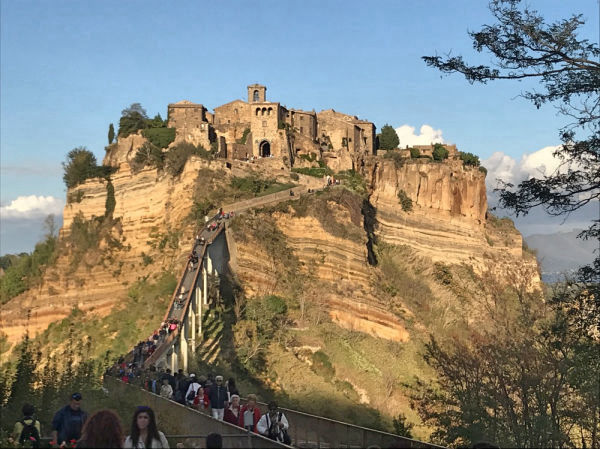
Perched atop a crumbling hill of volcanic tufa rock and clay, Civita di Bagnoregio is one of the most extraordinary villages in Italy. Often referred to as “La città che muore” (the dying city), it is known not just for its breathtaking setting but for its poignant story of geological vulnerability, human resilience, and cultural rebirth. Though technically located in the Lazio region, Civita is closely tied to Umbria both in landscape and spirit, and it has become an iconic symbol of central Italy’s enduring charm.
Origins and Ancient Roots
The origins of Civita di Bagnoregio date back over 2,500 years to the Etruscans, one of Italy’s earliest and most mysterious civilizations. The Etruscans built the original settlement on this high plateau for its defensible position and proximity to trade routes connecting the Tiber River valley to the rest of central Italy. The soft volcanic rock (tufa) made it easy to carve tombs, streets, and water systems, many of which can still be seen today in the surrounding cliffs.
In Roman times, Civita continued to thrive, but its true identity took shape in the medieval period, when it became a small but lively town surrounded by fortifications. It was during this time that the neighboring town of Bagnoregio developed below the hilltop, and the two settlements shared a long and intertwined history.
Decline and Geological Instability
The history of Civita di Bagnoregio is not just shaped by people, but by the land itself. The town sits on a fragile pedestal of tufa rock surrounded by clay-rich valleys prone to erosion and landslides. Beginning in the 17th century, a series of earthquakes and landslides destabilized the plateau, cutting off access routes and causing sections of the town to collapse.
Most devastatingly, in the 1695 earthquake, part of the village—including key civic buildings—slid into the valley below. Over time, many residents abandoned Civita and relocated to Bagnoregio, the safer town on more stable ground. With its only land connection eventually eroded, Civita became isolated and nearly uninhabited. Only a handful of families remained, and by the 20th century, the town was in serious danger of being lost entirely.
Cultural and Spiritual Significance
Despite its decline, Civita di Bagnoregio never lost its spiritual and cultural heart. The town is the birthplace of Saint Bonaventure (1221–1274), one of the greatest theologians and philosophers of the Franciscan Order. Though his family home has long since vanished due to landslides, his memory is honored in the town’s church, San Donato, located in the main square.
Civita’s narrow streets, medieval houses, and Romanesque churches preserve the atmosphere of a bygone era. Unlike many historic towns that have been modernized over time, Civita remains untouched by large-scale development, offering a rare opportunity to experience an intact medieval settlement. The silence of its empty lanes, the rhythm of the wind through stone arches, and the breathtaking views from its cliffside walls all contribute to its near-mythical status.
Modern Rediscovery and Tourism
In the late 20th century, Civita’s haunting beauty began to attract artists, writers, and photographers who were captivated by its dramatic setting and poetic decay. Slowly, efforts began to restore and preserve the town. A narrow pedestrian bridge was constructed, linking Civita to the modern world once more. This footbridge, which visitors must cross on foot, adds to the sense of journeying back in time.
Civita has since become a symbol of cultural preservation and sustainable tourism. Local and regional authorities, along with private citizens, have worked to stabilize the cliffs and maintain the ancient buildings. Today, while only a small number of permanent residents remain, the town hosts thousands of tourists each year, especially during festivals and holidays.
The influx of tourism has helped fund preservation projects and revive local traditions. Small artisan shops, wine cellars, and cafes have opened within the old stone houses, bringing life and livelihood back to the city without compromising its historical integrity.
A Symbol of Fragility and Resilience
Civita di Bagnoregio’s significance lies not just in its beauty or history, but in its profound symbolism. It stands as a reminder of the impermanence of human achievement, the power of nature, and the importance of safeguarding cultural heritage. In an age of rapid change and urban sprawl, Civita offers a rare glimpse of what can be saved through care, patience, and vision.
It also serves as a metaphor for resilience. Though threatened by time and geology, Civita has not died. It has adapted, redefined itself, and found new meaning in the modern world—becoming a living lesson in how communities can honor their past while embracing the present.
Conclusion
Civita di Bagnoregio is more than a picturesque hill town—it is a living monument to Italy’s layered history, a survivor of natural disaster, and a beacon of sustainable cultural tourism. With its ancient foundations, tragic decline, and remarkable revival, Civita tells a story that resonates far beyond its quiet stone walls. Whether seen from across the valley or experienced from within its narrow alleys, Civita invites visitors to reflect on the balance between nature and human endeavor, permanence and change, loss and renewal.