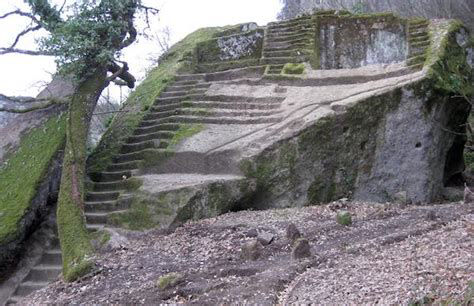
Etruscan pyramid or is it Rinaldonian?
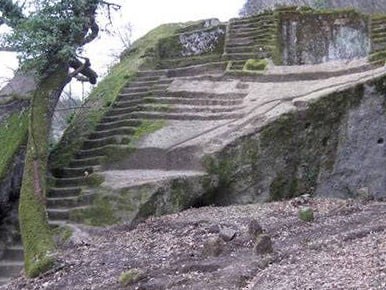
The monuments name is owed to its lateral pyramidal shape carved from natural magmatic rock, whilst its construction is probably first attributed to the Rinaldonian Civilisation that preceded the Etruscans. The Rinaldonian Civilisation emerged between 4000-2000 BC, and were highly skilled in working stone to construct complex ceremonial monuments.
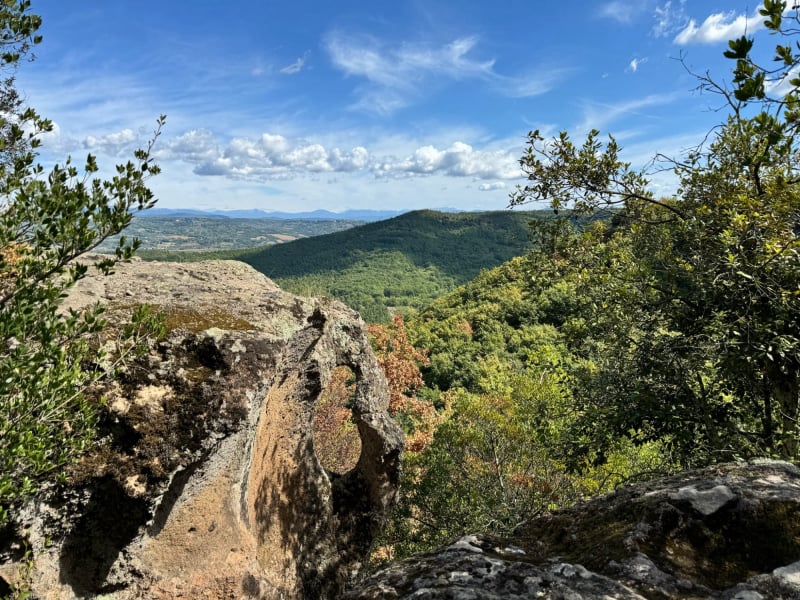
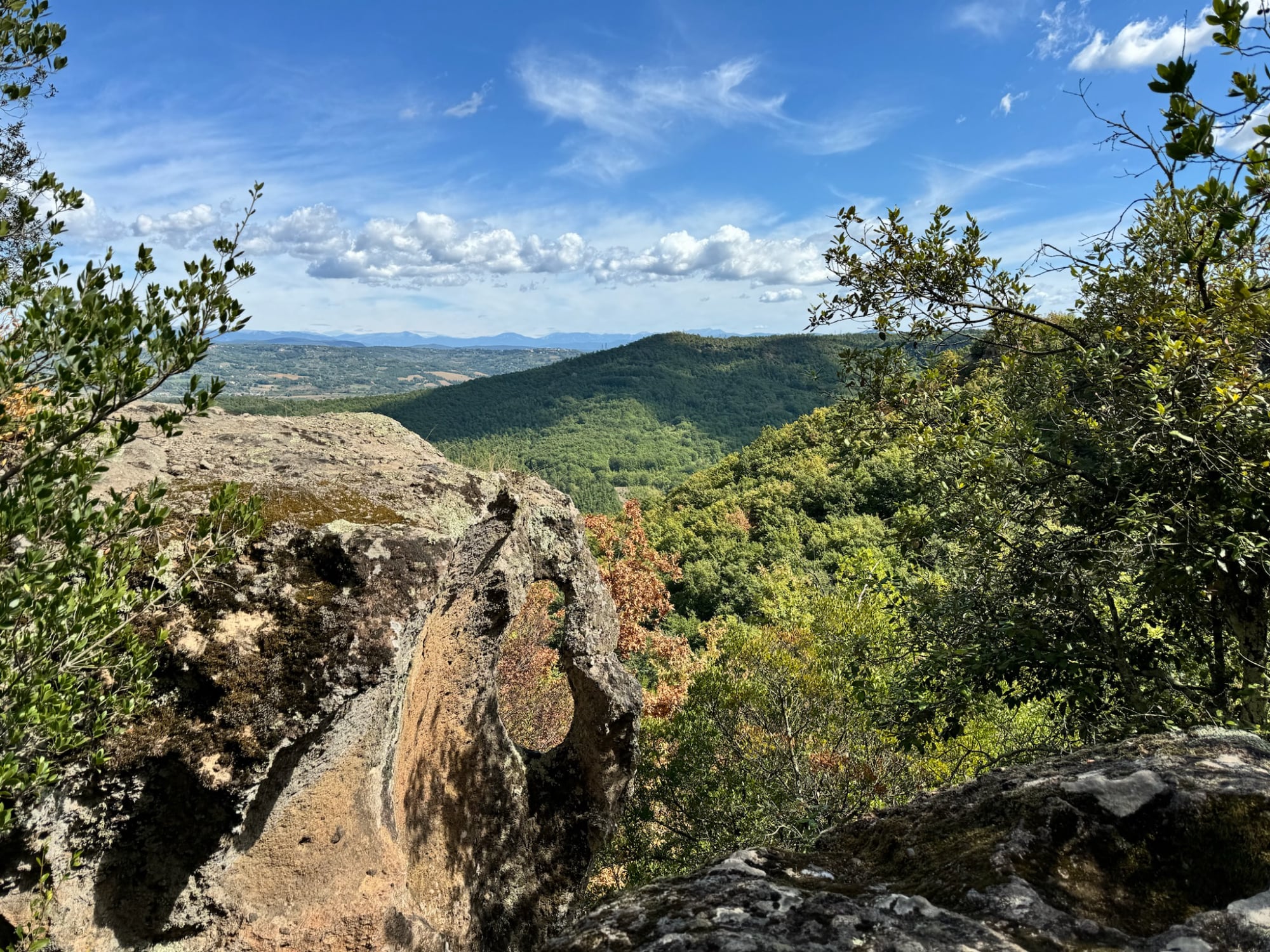
This place is a good mix of history, nature and exercize!
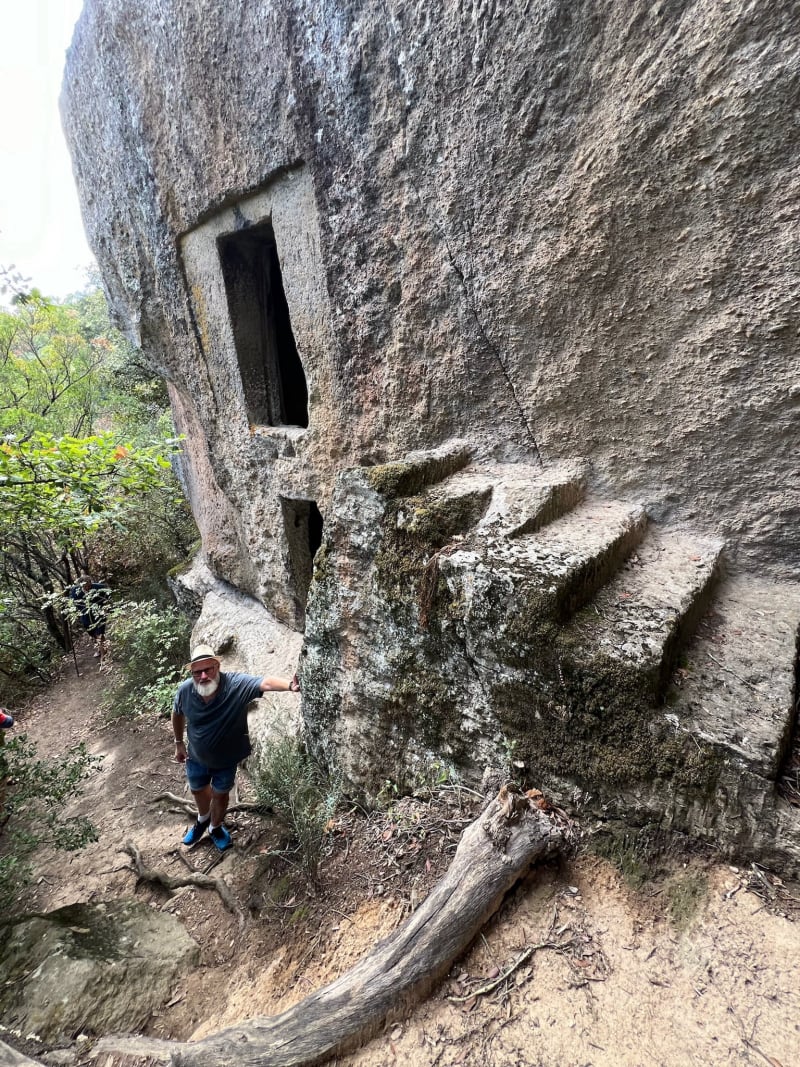
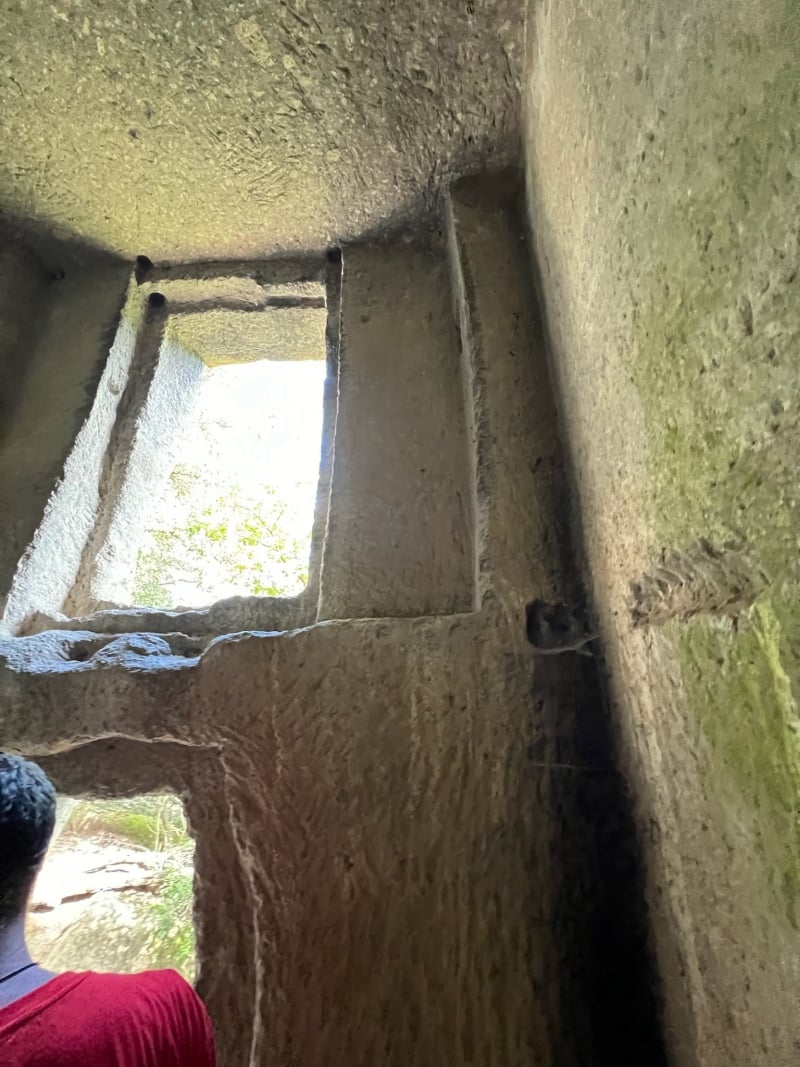
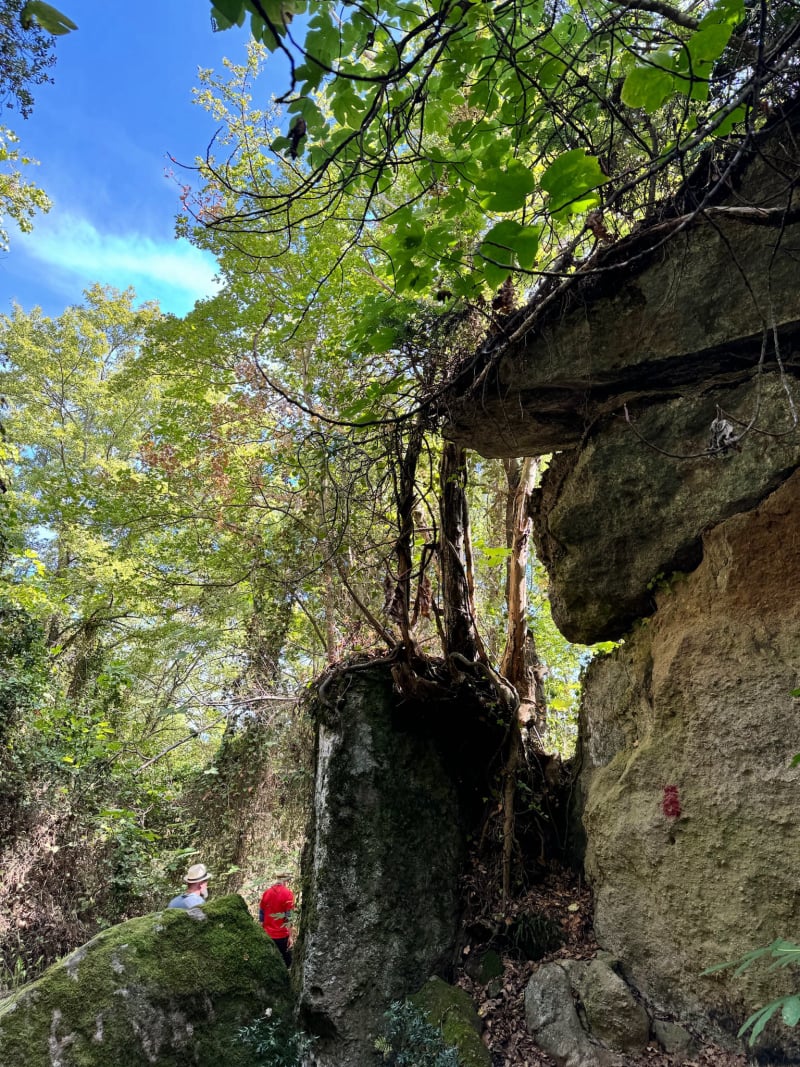
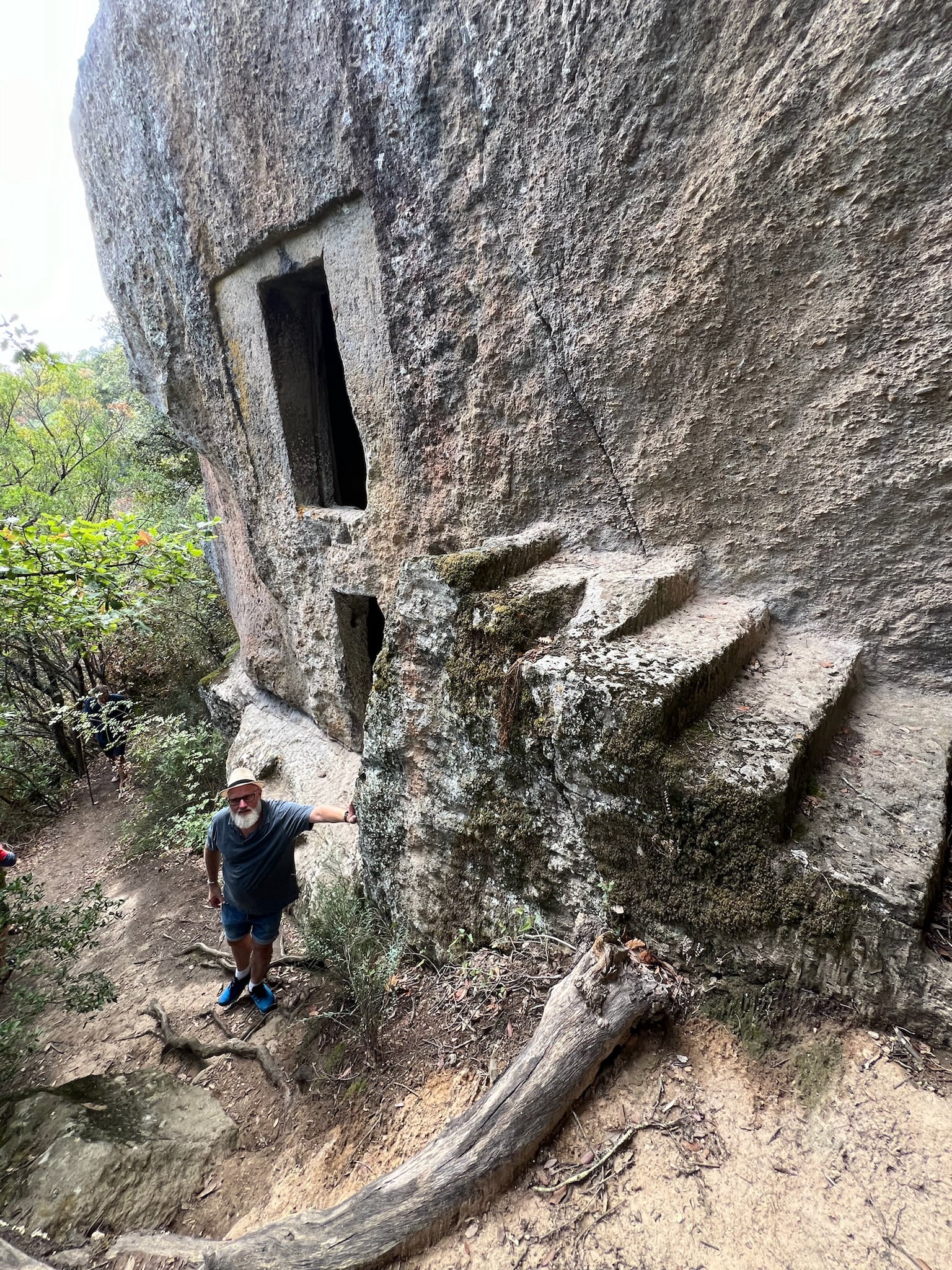
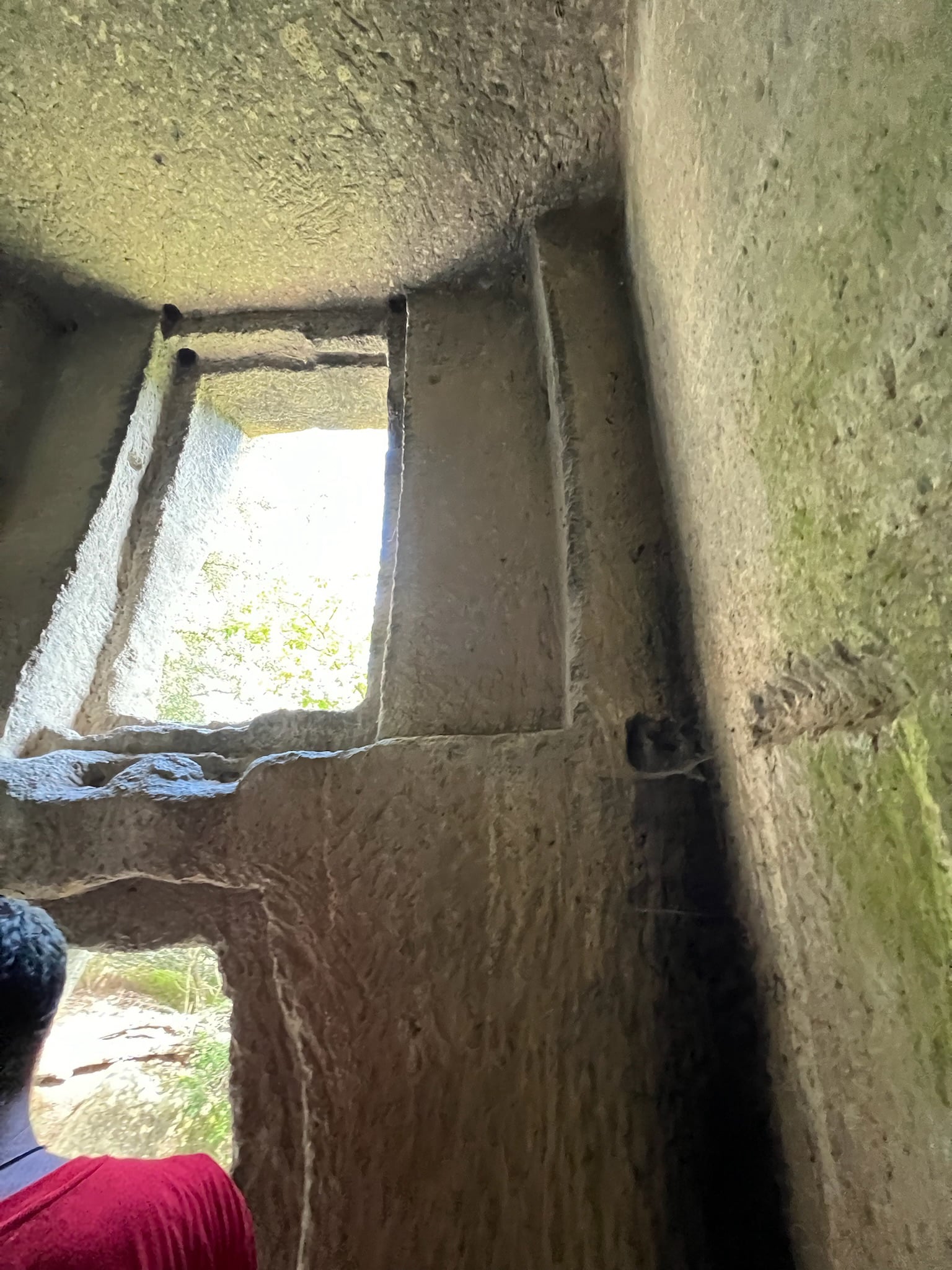
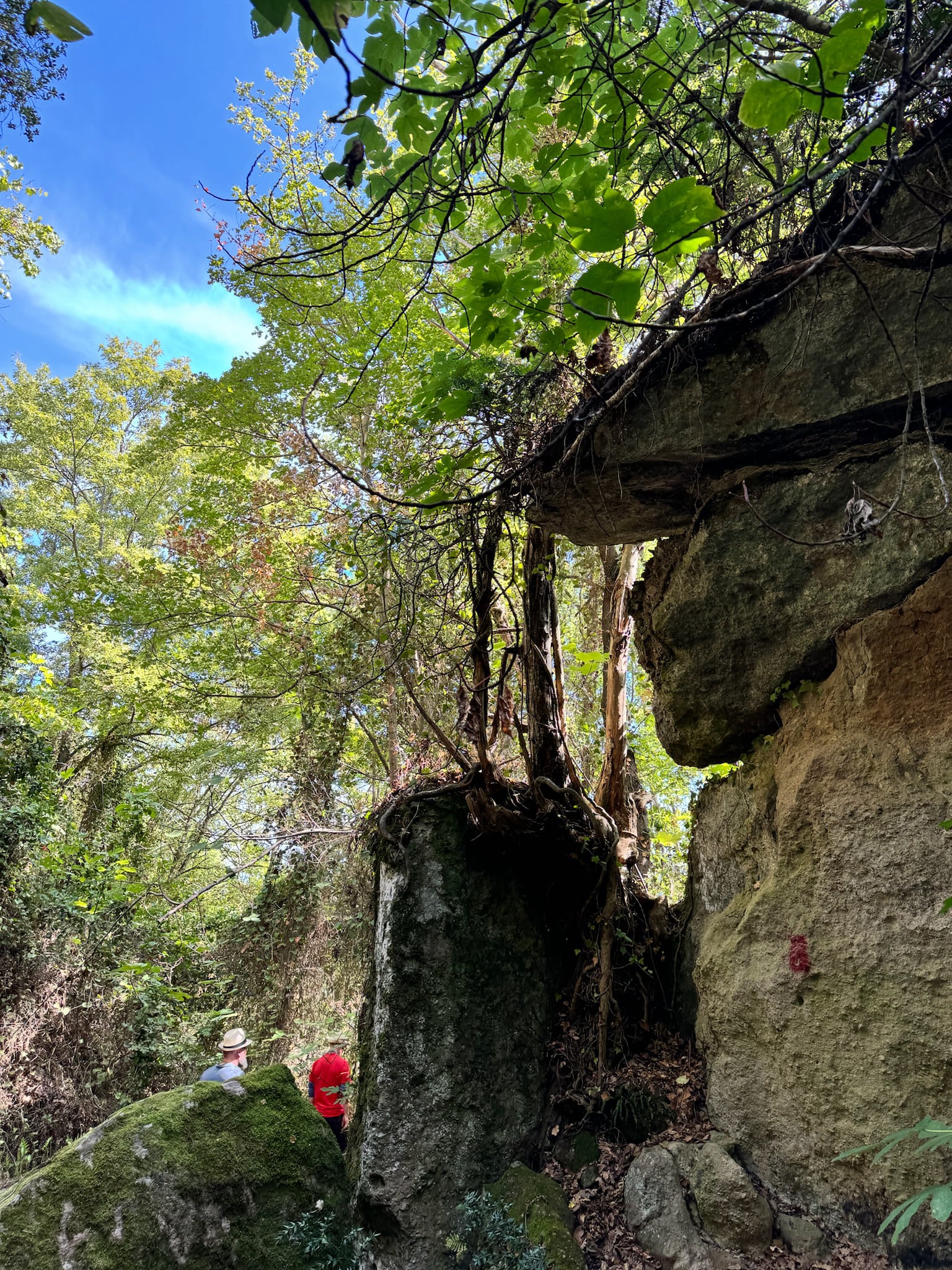
Hint: When you are there you should check out the cool little Etruscan condominium carved out in the soft tufo rock (see the map at the bottom of the page for the location).
Website
You can find pictures and directions at the bottom of this page.
Etruscan pyramid or is it Rinaldonian?
Historical Context
The Etruscans and Their Culture
The Etruscans were a prominent ancient civilization in central Italy (roughly 900–100 BC), flourishing in regions of present-day Tuscany, Umbria, and northern Lazio. They developed a rich culture with advanced art, metalwork, and urban centers well before the rise of Rome. In religion, the Etruscans were polytheistic and highly ritualistic – they practiced augury (divination from the flight of birds or lightning), elaborate funerary customs, and animal sacrifice to a pantheon of gods. Many of their sacred activities took place in temples or sanctuaries, but they also engaged with the natural landscape for spiritual purposes. Etruscan architecture often utilized local tufa (volcanic stone) for tombs and monuments; their rock-cut necropolises (such as those at Cerveteri and Tarquinia) are famous. The Pyramid of Bomarzo fits into this cultural background as a likely Etruscan sacred site, reflecting how this civilization integrated their religious practices with the landscape. If indeed an Etruscan creation, the Bomarzo monument underscores the Etruscan penchant for monumentalizing natural rock formations into ritual spaces. It also highlights their focus on the afterlife and the divine: for instance, the orientation and form of the structure suggest it may have been dedicated to chthonic (underworld) deities, aligning with Etruscan beliefs in gods of the underworld and fate. In short, understanding the Pyramid of Bomarzo requires first understanding the Etruscans – a people who heavily influenced Roman civilization and left behind mysterious, fascinating structures that continue to intrigue archaeologists and historians.
Discovery and Physical Description of the Bomarzo Pyramid
The so-called Etruscan Pyramid of Bomarzo, also nicknamed “Sasso del Predicatore” (Preacher’s Rock), remained hidden for centuries under dense forest until its relatively recent “discovery.” Local residents had long been aware of a giant moss-covered boulder with steps in the woods of Bomarzo. However, it wasn’t scientifically documented until the 1990s. In 1991, a group of local researchers (including Giovanni Lamoratta and Giuseppe Maiorano) identified the stone as a man-made structure during an exploration. For years it remained largely overgrown and unstudied. In 2008, Salvatore Fosci – a resident and owner of nearby land – took it upon himself to clear thick vegetation and soil from the structure, revealing its full form. Fosci’s cleaning effort unveiled a massive, terraced rock monument carved from the area’s volcanic tufa stone (known as peperino).
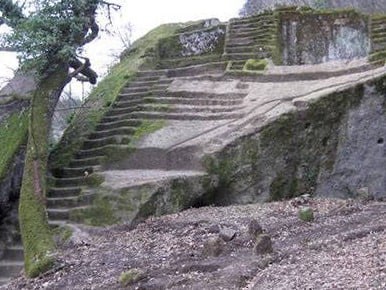
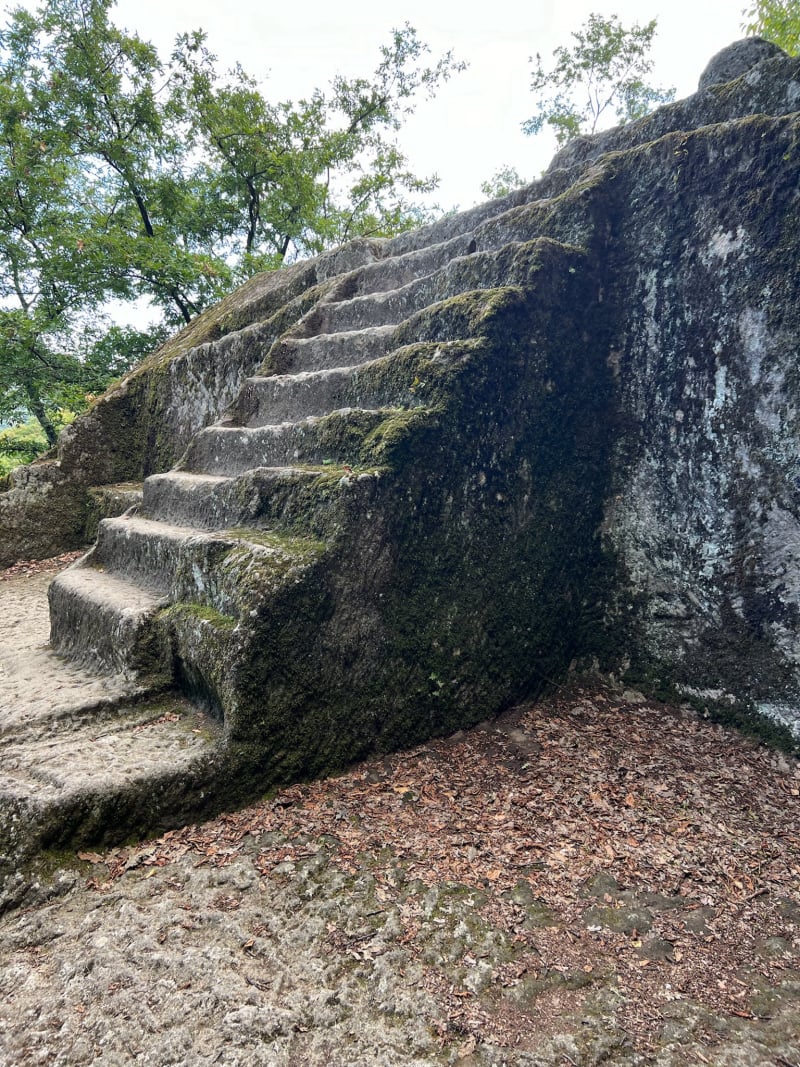
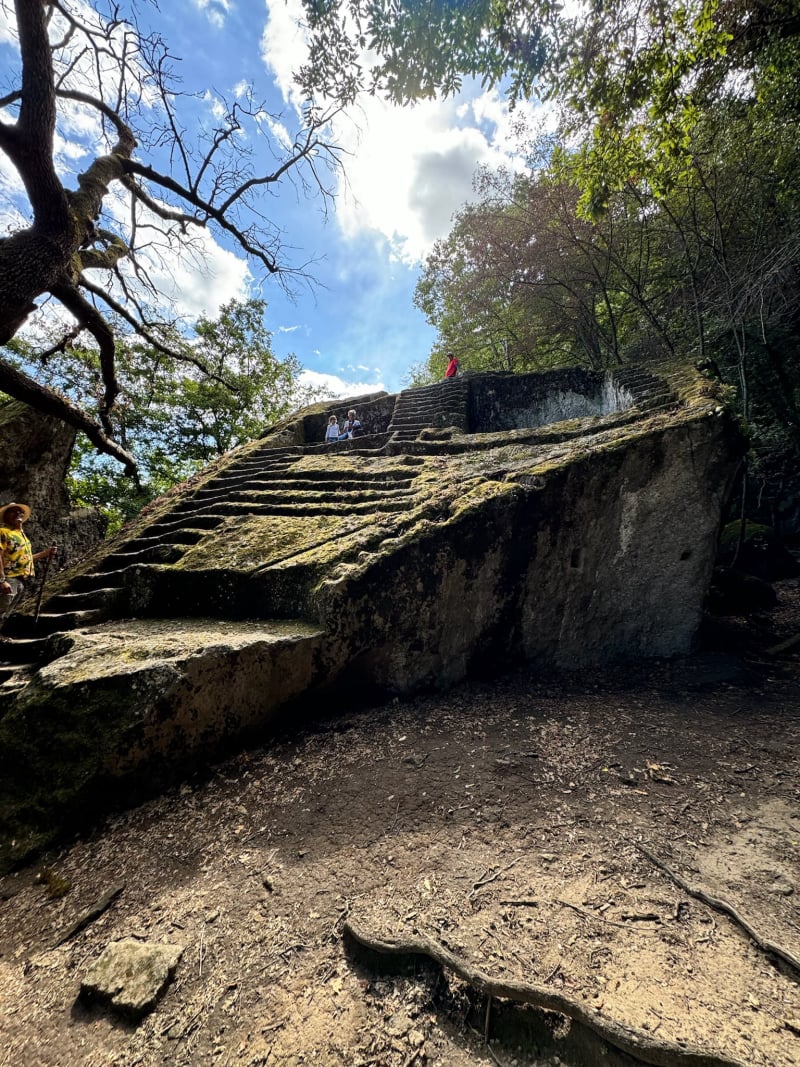
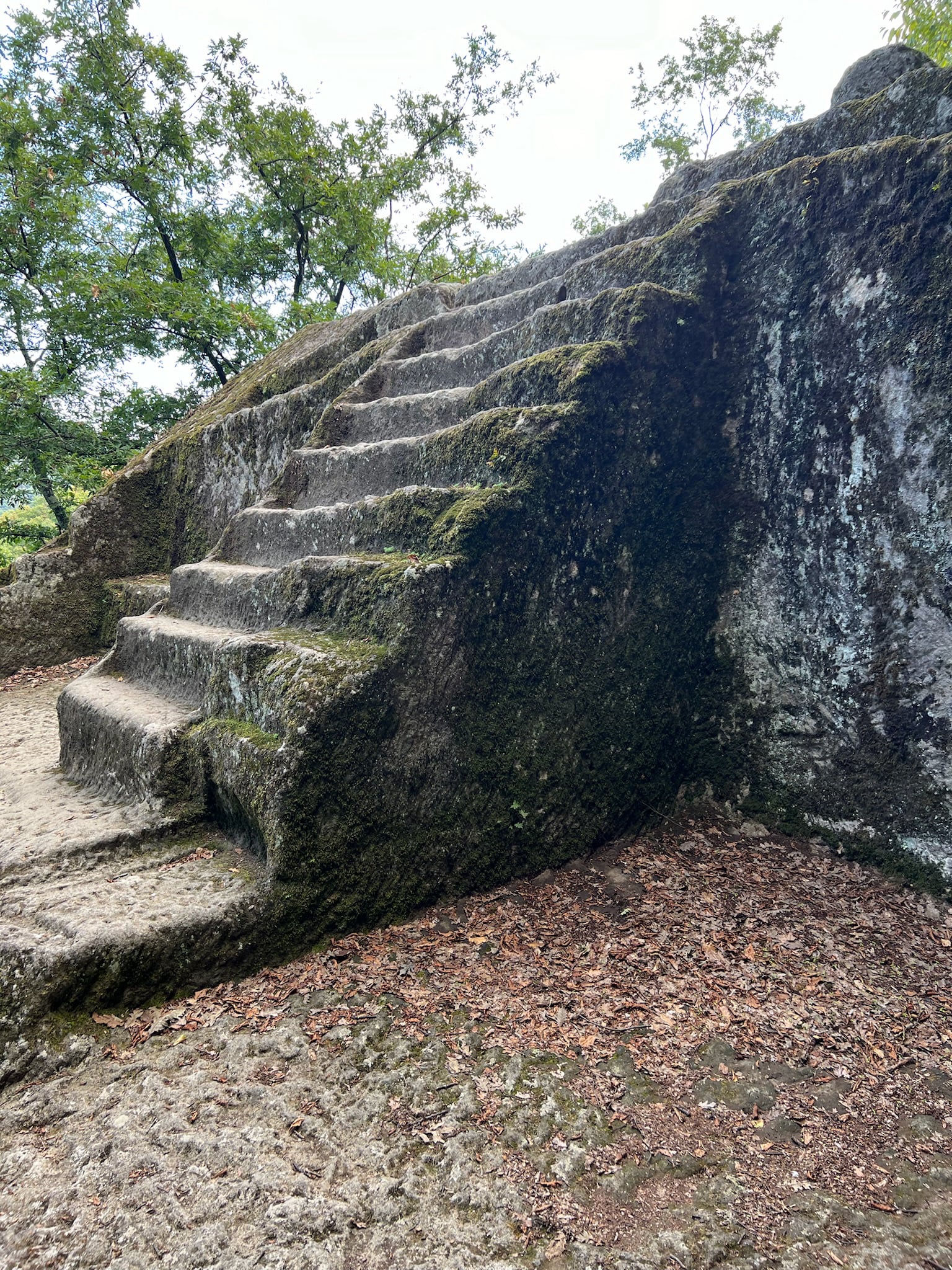
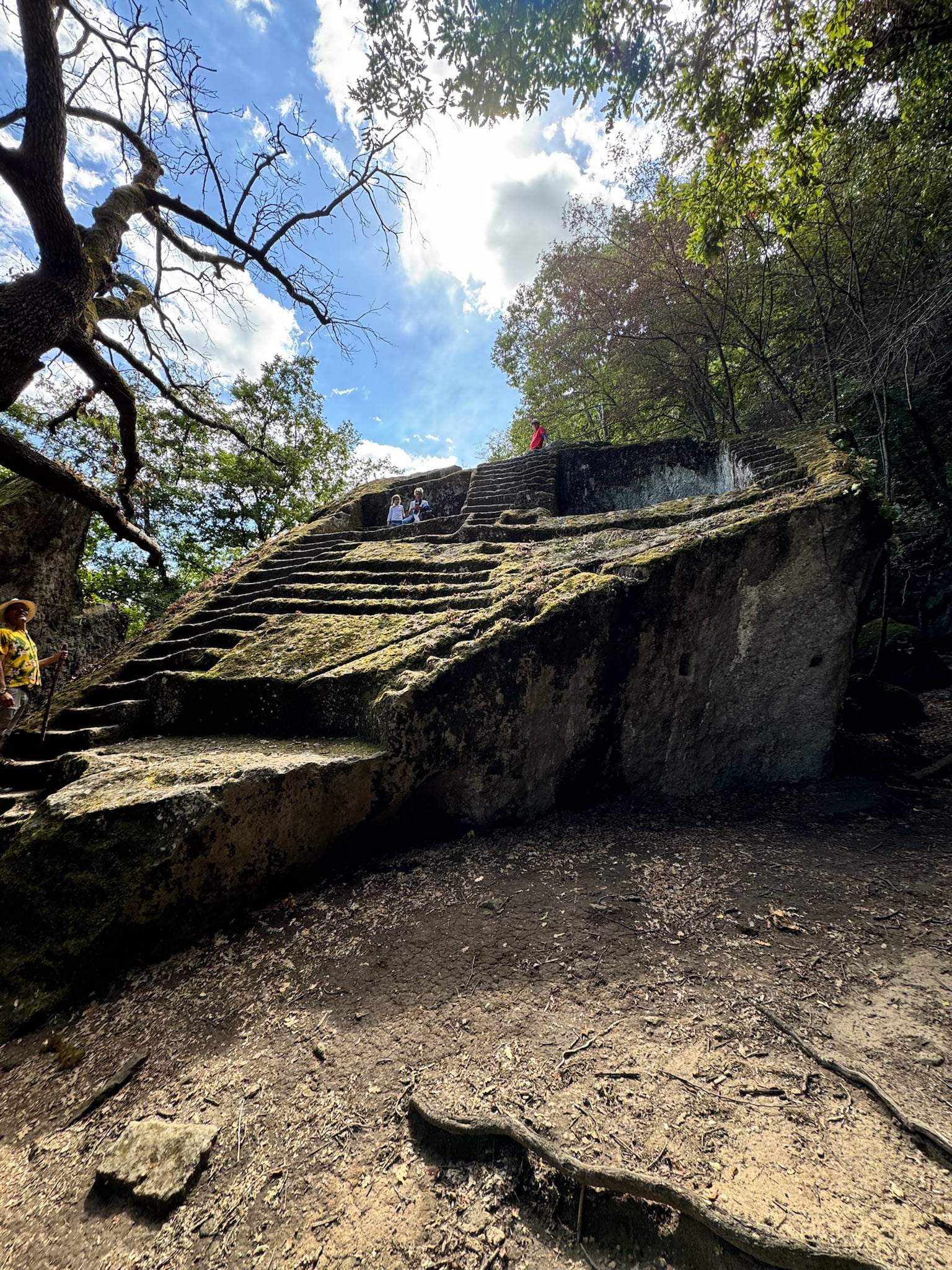
Physically, the Bomarzo Pyramid is an enormous monolith shaped into a multi-tiered, truncated pyramid. It measures approximately 8 meters high on its uphill side and 16 meters on the downhill side, owing to the sloping terrain. This makes it arguably the largest rock-cut monument in Europe. The structure features a grand staircase of 26 steps cut into the rock leading up from the base. These steps ascend to a small intermediate terrace. At that point, a second staircase of 9 additional steps branches off, leading to the uppermost platform . In total, the monument has 35 steps arranged in two flights (26 lower + 9 upper) separated by a landing – a layout reminiscent of a primitive ziggurat or Mesoamerican pyramid in miniature form . Each step is rock-cut, with some steps broadened on one side; a carved seat or throne is even hewn into the intermediate platform, perhaps for a priest or officiant .
The top of the pyramid is a flat area (the “altar” surface) large enough for a few people to stand on. The sides of the monument exhibit intriguing features: niches, basins, and channels are carved into the flanks of the rock . Two large recesses on the sides are edged by small scooped depressions (vaschette) and gutters (canaletti) . These appear designed to collect or channel liquids, which has fueled theories about ritual libations or blood from sacrifices (discussed later). The entire monument was laboriously carved out of a single massive boulder of peperino, likely fallen from the nearby cliff in prehistoric times . Its shape is not a perfect geometric pyramid, but a rough, asymmetrical pyramid-like mound with staircases – hence it is often called a pyramidal altar. The local name “Sasso del Predicatore” (Preacher’s Rock) comes from the image of someone standing atop the stone addressing people below, as on a natural pulpit. Hidden in the forest and covered in lichen, the Bomarzo Pyramid emanates an ancient and mysterious aura. Hikers approaching through the woods of Monte Casoli often describe the first sight of it as breathtaking – a gigantic, unexpected stairway rising from the earth, cloaked in deep green foliage.
Archaeological Studies and Interpretations
Despite its impressive nature, the Pyramid of Bomarzo remained outside of formal archaeological attention for many years. Official studies or excavations have yet to be carried out on this monument . The site is essentially in situ in the woods, without extensive protective measures or detailed stratigraphic digs. Thus, much of what is “known” comes from observational surveys by independent researchers, local historians, and a growing interest in the academic community spurred in the 2010s. Archaeologists broadly concur that the Bomarzo Pyramid was a sacred structure, likely an altar used for worship . Its design – a truncated pyramid with stairs – has no practical domestic purpose, pointing instead to ceremonial use. That said, in the absence of artifacts (like pottery or tools) or inscriptions, interpretations rely on analogies and context.
Some insight comes from the surrounding area. The pyramid is located in an archaeological-rich zone on the slopes of Monte Casoli. Nearby are Etruscan “tagliate” (cut roads through tufa rock), chamber tombs of the Necropoli di Santa Cecilia, and even Paleochristian burials . This indicates that the area was inhabited or utilized across many eras – from Bronze Age or Iron Age peoples up through Etruscans and into Roman and later times. The presence of rock-cut tombs and other altars in the vicinity supports the notion that Bomarzo’s pyramid was part of a larger sacred or funerary landscape.
In terms of dating, no definitive chronology is established yet. Archaeologists tentatively date the monument to the Etruscan period, roughly between the 7th and 5th centuries BC (the Archaic to Classical Etruscan era) . This date range is hypothesized based on the style of the cuts, comparisons to other Etruscan rock altars, and the context of nearby Etruscan remains. One local archaeologist, Luciano Proietti, conducted quantitative studies and suggested interpretations aligning with an Etruscan date, while also analyzing its dimensions and geometry. Meanwhile, an archaeoastronomy study by Adriano Gaspani examined the pyramid’s alignments (discussed below) and considered the possibility of a Villanovan-era origin (c. 9th–8th century BC), which would place it in a proto-Etruscan timeframe . Some even speculate a prehistoric origin – for example, that it could have been first carved by the Rinaldonian culture in the Bronze Age (2nd millennium BC) and later adopted by Etruscans. These earlier datings remain hypotheses; without excavations or carbon dating of any organic remains on site, they are not confirmed.
What is clear from studies so far is the function: scholars identify the Bomarzo Pyramid as a monumental rock altar. Its very uniqueness (no other identical structure in Italy) makes it hard to interpret, but also indicates it had special significance . No evidence of it being a building foundation or a fortification exists – everything points to ceremonial usage. Researchers note that Etruscans did perform rituals on elevated outdoor altars; for instance, some Etruscan temples had high podiums with stairways. The Bomarzo Pyramid could be an exaggerated version of that concept, taken out of an urban context and placed in nature. Given the lack of systematic archaeology, much of the interpretation work has also involved comparative approaches – comparing the pyramid to known structures (like altars in Etruscan sanctuaries or even to step pyramids in other cultures) to guess its purpose. In summary, while formal archaeological data is sparse, the consensus view emerging from expert analyses is that Bomarzo’s pyramid was a place of worship, likely created by the Etruscans, serving a ritualistic role in their society .
Theories about Its Purpose
Over the years, various theories have been proposed to explain the original purpose of the Bomarzo Pyramid. Without inscriptions or written records, these theories are based on the monument’s form and context. The main hypotheses include:
Ceremonial Altar for Religious Rites
The most widely accepted view is that the Bomarzo Pyramid served as a ritual altar. Its shape – a stepped platform – is ideal for religious ceremonies, allowing priests to ascend and perform rites in view of onlookers gathered below. Archaeologists note that its truncated pyramid form immediately suggests an altar for sacrifices or offerings . The Etruscans often worshipped in open-air settings, and this could have been a site for propitiatory rituals to secure the favor of the gods. The orientation and features support this: the channels and basins carved into the rock were likely meant to drain libations or blood from animal sacrifices . In Etruscan religion, sacrifice (of animals, and possibly symbolic offerings of liquids) was a key component. The pyramid’s northwest alignment is also telling – in Etruscan cosmology, the northwest was associated with the underworld. One interpretation is that a priest climbed the 26-step stair to the mid-terrace, then the remaining 9 steps to the upper altar (ara), and there officiated rites dedicated to the “Infernal” gods (gods of the underworld) . This would explain the local lore of it being a place where a sacerdote etrusco (Etruscan priest) conducted ceremonies to the unseen powers beneath the earth. Given these points, a ceremonial altar usage – possibly for seasonal rites, sacrificial ceremonies, or cult gatherings – is strongly supported.
Funerary or Memorial Monument: Another theory posits a funerary purpose. The Etruscans built monumental tombs, but the Bomarzo structure is not a tomb in itself (no internal chamber for a burial). However, it could have been a focal point in funeral or memorial rituals. Perhaps it was an elevated platform where the deceased were eulogized or where certain funerary rites were performed before burial in the nearby necropolis. The proximity of tombs and a prehistoric necropolis (Santa Cecilia) suggests a link between the pyramid and the domain of the dead. It might have also served as a cenotaph (an “empty tomb” or monument honoring the dead) or a cult site for ancestor worship. Still, this theory is less emphasized by experts since the physical design – especially the drainage channels – fits sacrificial rites more than any known funerary practice.
Astronomical Observatory or Calendar Marker: Intriguingly, some researchers have explored the idea that the pyramid had an astronomical function. Archaeoastronomers studying the site found that from the top platform, one has clear lines of sight to the horizon in certain directions . The positioning of the structure, they argue, is compatible with observing solar and lunar movements as well as specific stars. For example, calculations showed that an observer on the pyramid could track the setting of bright stars like Sirius and Antares at particular times of year . Adriano Gaspani’s study (2015) suggested that the pyramid could align with celestial events, perhaps used to time agricultural or religious calendars akin to an Etruscan “astronomical observatory.” The steep stairway might symbolize ascending toward the heavens, and the act of observing the sky from a high place has ritual connotations. However, this theory does not necessarily contradict the altar theory – it could have been both a place of worship and observation. Many ancient cultures’ sacred sites doubled as observatories (e.g., Mesoamerican pyramids were used for both rituals and watching the stars). The comparison to Mesoamerican pyramids and Mesopotamian ziggurats has been drawn explicitly . Still, given the Etruscans left no known written astronomical records at Bomarzo, this idea remains speculative but fascinating.
Other or Multi-purpose Theories
A few other creative theories exist. Salvatore Fosci, the caretaker, half-jokingly theorized that the site might have been an ancient “refrigerator” or storage site – essentially a place to store food (perhaps using the cool of the stone) for an ancient community . While this notion is not widely taken up by scholars (and the sacred nature of the structure makes it unlikely to be merely utilitarian), it reflects the local intrigue and attempts to explain every feature. Another idea is that the pyramid may have been a territorial marker or a place of assembly for a proto-historic community, given its prominence. Some have wondered if it had multiple phases of use: perhaps first as a sacred shrine in prehistoric times, later adopted or re-purposed by Etruscans for their rituals. In any case, the prevailing opinion is that the Pyramid of Bomarzo was fundamentally a religious monument, most likely an altar for ceremonies – possibly complemented by uses like sky-watching or serving as a stage for important community rites. Its uniqueness means it may have fulfilled a special cult function that doesn’t have a direct parallel elsewhere.
Significance of the Monument in Understanding Etruscan Civilization
The Etruscan Pyramid of Bomarzo is an invaluable piece in the puzzle of understanding Etruscan (and central Italian) civilization. First and foremost, it underscores the ritual ingenuity of the Etruscans – their ability to harness the natural landscape for spiritual purposes. Unlike the more commonly studied Etruscan tombs or the foundations of temples in urban centers, this monument suggests that Etruscans also sanctified natural sites in the wilderness, carving massive rocks into sacred altars. This broadens our perspective of Etruscan sacred architecture, revealing that not all Etruscan religious activity was confined to cities or necropolises. The Bomarzo pyramid could represent a rural cult site where perhaps multiple communities came together to worship, indicating a form of regional or folk religious practice parallel to the state-sponsored temple rituals.
Moreover, the monument’s apparent alignment with underworld symbolism (northwest orientation and sacrificial drains) provides insight into Etruscan theology. The Etruscans were deeply concerned with the afterlife and the gods of the underworld (such as Aita and Phersipnai, their equivalents of Hades and Persephone). A large altar facing the direction of the underworld gods suggests ceremonies to honor or appease those deities, potentially shedding light on the kinds of rituals described in Etruscan religious texts (like the Libri Rituales and Libri Acherontici, which unfortunately survive only in fragments or descriptions). It emphasizes that sacrifice and blood rituals were likely integral to their worship – something we know from Roman accounts of Etruscan practices and from art on Etruscan tomb walls.
The Bomarzo Pyramid’s unique design also invites comparisons and influences. Scholars often call it “the largest altar rupestre (rock altar) in Europe”. As such, it becomes a key reference point when comparing ancient European cultures. If it indeed dates to around the 6th century BC, it shows Etruscans achieving a scale of rock-cut monumentality comparable to other ancient societies. If parts of it are older, it might indicate that central Italian peoples were creating ceremonial megaliths even in the Bronze Age, linking to a broader Eurasian tradition of megalithic cult sites. In either case, the pyramid serves as evidence of a continuous sacred landscape: from the Copper/Bronze Age (Rinaldone culture) through Villanovan into the Etruscan period, the region around Bomarzo remained spiritually significant . This continuity is a topic of great interest, as it suggests that later cultures (Etruscans) might have inherited and repurposed holy sites from their ancestors, maintaining traditions over millennia.
In understanding Etruscan civilization, which still holds many mysteries (their language, for example, is only partially understood), the Bomarzo Pyramid is a tangible, if enigmatic, clue. It highlights the Etruscan relationship with nature and the divine. Unlike the Romans who built grand temples in marble, the Etruscans here chose a living rock in a forest as an altar – implying a perhaps more animistic or nature-centered aspect of their religion than we typically acknowledge. It also has educational significance: archaeologists and historians use the site to engage the public with Etruscan heritage, showing that there is more to Etruscan culture than just their famous painted tombs or gold jewelry. Each investigation or theory about the pyramid spurs further questions about Etruscan engineering (how did they carve it?), social structure (what kind of priesthood or community effort was needed to create it?), and religious practices (what rituals were conducted there?). In sum, the Pyramid of Bomarzo is significant not only as a curiosity but as a cultural touchstone that connects modern observers with the spiritual life of the Etruscans.
Current Status and Cultural Value Today
Today, the Etruscan Pyramid of Bomarzo stands as both an archaeological treasure and a somewhat hidden gem for cultural tourism. It is located within the Riserva Naturale Monte Casoli di Bomarzo, a provincial nature reserve, which offers it a degree of protection as part of the natural landscape. There is growing recognition of its value: local municipalities and the Lazio region have included it in brochures and websites showcasing the historical heritage of the Viterbo area. However, the site is not (as of 2025) a fully developed tourist attraction – there are no extensive on-site facilities or signage, and reaching it involves a hike through woodland trails. This has preserved an adventurous quality for visitors; many describe the journey to find the pyramid as a little “Indiana Jones” expedition .
Enthusiast groups and tour guides have stepped in to improve accessibility. Organizations like Guide Viterbo offer guided visits to the pyramid, educating visitors on its history and the surrounding archaeological context . Online travel blogs (and even YouTube videos) have shared GPS coordinates and hiking instructions to locate the monument . This community-driven approach has heightened the pyramid’s profile, attracting history buffs, hikers, and photographers intrigued by its mystique. Importantly, Salvatore Fosci, the local guardian of the site, continues to play a crucial role. Often, he or other volunteers will accompany tours or be present near the pyramid to ensure the paths are clear and to share stories. Fosci’s dedication – clearing foliage, maintaining the trail, and promoting the site on social media and television – has been pivotal in preserving the pyramid . Thanks to these efforts, the site, once nearly forgotten, now sees a steady trickle of visitors and has been featured in regional news and cultural programs.
The cultural value of the Bomarzo Pyramid today is multifaceted. For the local community of Bomarzo and Viterbo province, it is a source of pride and identity, highlighting the deep historical roots of their territory. It complements Bomarzo’s other attractions (such as the Renaissance-era Park of the Monsters) by adding an ancient Etruscan dimension to the area’s significance. Locals sometimes organize hikes or educational outings, especially around dates of cultural importance, to reconnect with this ancestral site. There have been proposals to further study and officially protect the pyramid – potentially turning it into an open-air archaeological park. Scholars argue that a proper archaeological excavation and conservation plan would not only preserve the stone from erosion but also possibly unearth artifacts or evidence to clarify its age and use.
Internationally, as knowledge of the site spreads, the Bomarzo Pyramid contributes to the broader appreciation of lesser-known archaeological heritage. It stands as a reminder that spectacular ancient monuments aren’t only the well-touristed ones (like the Colosseum or Pompeii) but also those hidden in forests, awaiting discovery. Efforts by heritage organizations and universities could soon increase; for instance, surveys with advanced tools (like 3D laser scanning and drone photography) have been suggested to document the pyramid in detail for virtual study and preservation.
In conclusion, the Etruscan Pyramid of Bomarzo has transitioned from obscurity to being recognized as a culturally significant monument. It embodies the intersection of nature, history, and mystery – a place where one can quite literally step into the past. Its ongoing story, from ancient altar to modern hiking destination, reflects the enduring allure of the Etruscan legacy in Italy. As research continues and awareness grows, this unique pyramid will likely gain even more prominence as a key to unlocking secrets of Etruscan civilization, all while remaining a captivating site for future generations to value and protect.
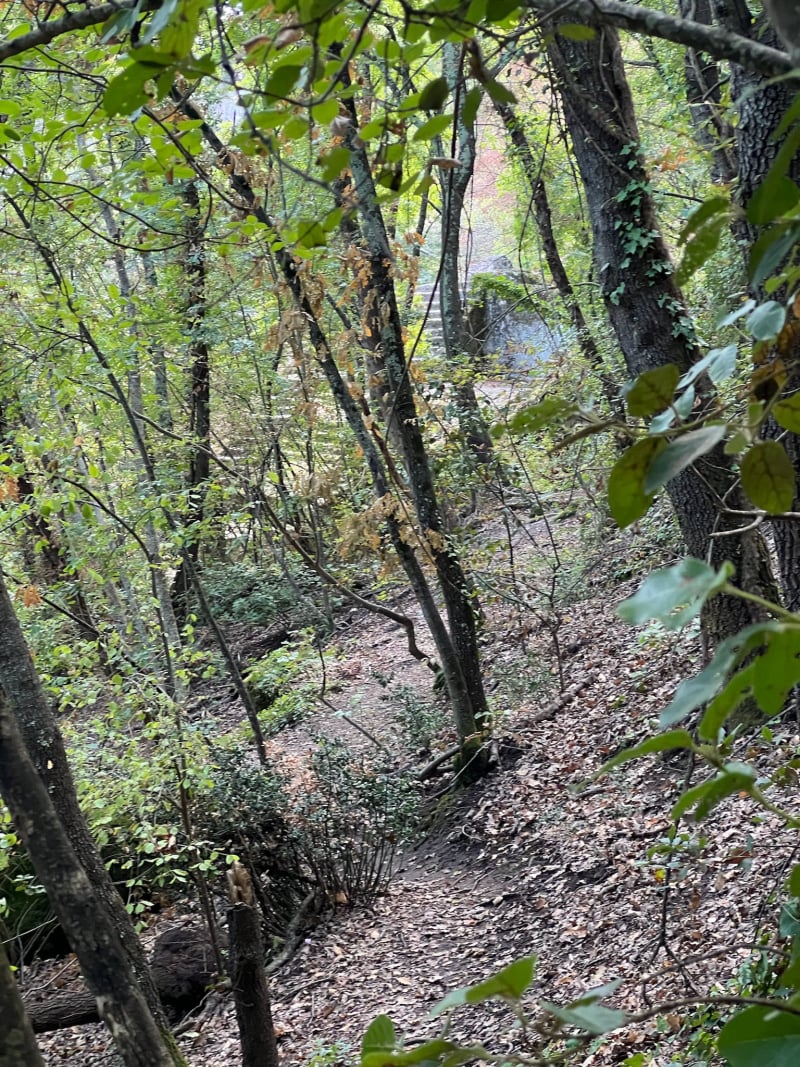
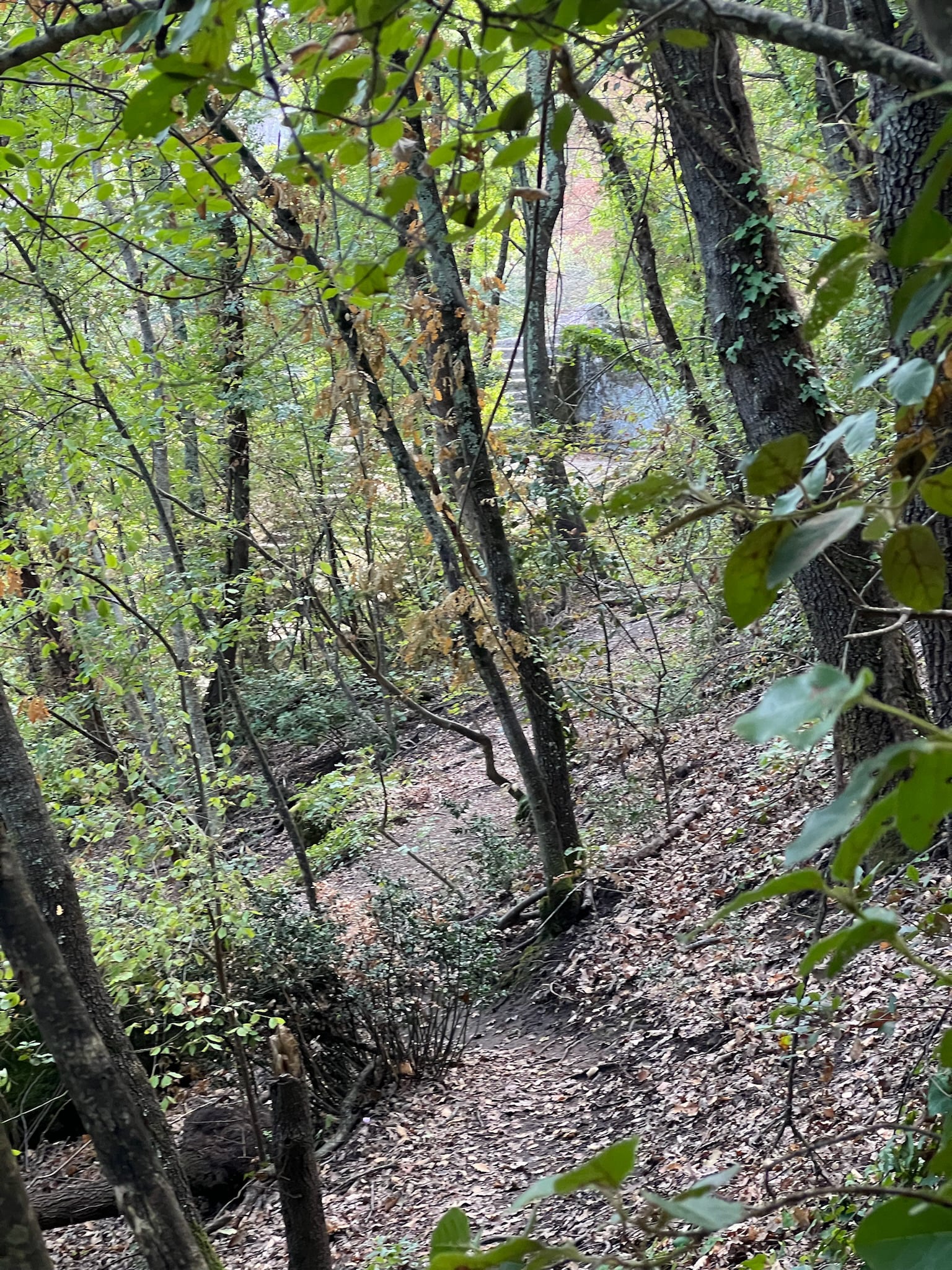
The Etruscan pyramid is placed in a rural area outside Bomarzo where there is no easy parking, so you are recommended to park at the intersection between Via dell'Elce and Via Cupa.
Walk straight along Via Cupa.